AthleticsAthletics world record
3000 m steeplechase, men
7 min 52.11 s
- Holder
- Lamecha Girma
- Date
- Place
- Paris
- Standing since
- 2023 (3 years)
✓ Value cross-checked in a second source

How the record evolved
The last record set in each decade, up to the current record (highlighted).
| Year | Record | Holder |
|---|---|---|
| 7 min 52.11 s | Lamecha Girma | |
| 7 min 53.63 s | Saif Saaeed Shaheen (QAT) | |
| 7 min 55.72 s | Bernard Barmasai (KEN) | |
| 8 min 05.35 s | Peter Koech (KEN) | |
| 8 min 05.4 s | Henry Rono (KEN) | |
| 8 min 22.2 s | Vladimir Dudin (URS) | |
| 8 min 32.0 s | Jerzy Chromik (POL) |
Put them in order
Sort these records from the oldest to the most recent.
- 7 min 55.72 sBernard Barmasai (KEN)
- 8 min 32.0 sJerzy Chromik (POL)
- 7 min 52.11 sLamecha Girma
- 8 min 05.4 sHenry Rono (KEN)
What to remember
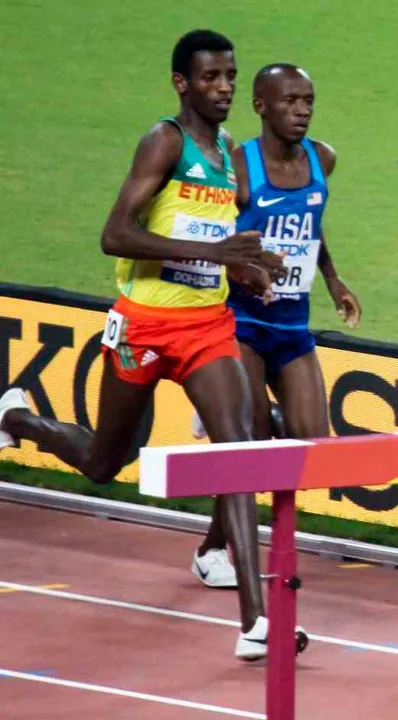
An obstacle race named after the steeplechase of horse racing, the 3000 m is the most common distance of the discipline. On June 9, 2023, at the Meeting de Paris, Ethiopia's Lamecha Girma covered it in 7 min 52.11 s, an average of 22.876 km/h with the barriers included.
Decade after decade, the time slowly came down. In 1958 the best mark stood at 8 min 32.0 s, by Jerzy Chromik. In 1978 Henry Rono was down to 8 min 05.4 s; in 1997 Bernard Barmasai clocked 7 min 55.72 s; in 2004 Saif Saaeed Shaheen reached 7 min 53.63 s. Across the 65 years between the 1958 mark and the 2023 one, the time fell by 7.8%.
Girma has collected silver medals at the 2019, 2022 and 2023 World Championships and at the Tokyo Olympics. A few months before Paris, on February 15, 2023, he had also broken the indoor 3000 m world record, at the Meeting Hauts-de-France Pas-de-Calais.
Related records
Sources and licences
- Value, holder and date: Wikipedia article “List of world records in athletics” (revision used 1378411308). Data from Wikipedia, licensed under CC BY-SA 4.0.
- Photo: filip bossuyt from Kortrijk, Belgium, Photo licensed under CC BY 2.0 (Wikimedia Commons). Remove this photo.
Guess another record
AthleticsLoading the question…