EngineeringEffective aperture (two 8.4 m mirrors combined)
Largest optical telescope
11.9 m
39.0 ft
- Record holder
- Large Binocular Telescope
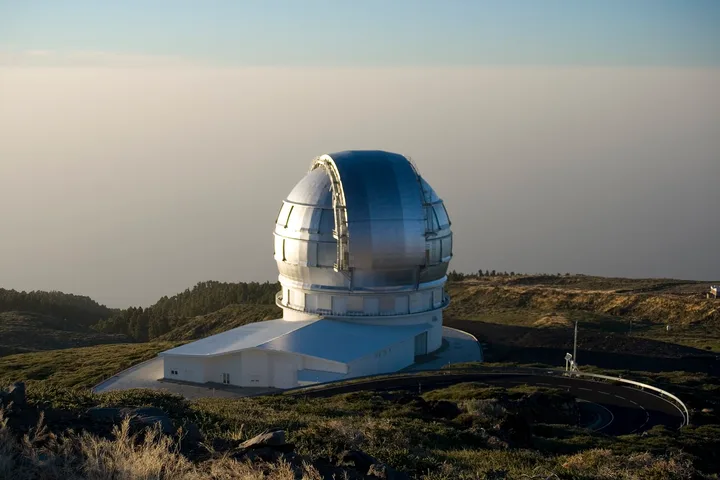
The LBT's two mirrors give it the same light-gathering ability as an 11.8 m wide single circular telescope.

How the record evolved
The last record set in each decade, up to the current record (highlighted).
| Year | Record | Holder |
|---|---|---|
| current | 11.9 m | Large Binocular Telescope |
| 10 m | Keck 1 | |
| 6 m | BTA-6 | |
| 5.08 m | Hale Telescope | |
| 2.54 m | Hooker Telescope | |
| 1.83 m | Leviathan of Parsonstown | |
| 1.26 m | Herschel's 40-foot telescope | |
| 0.60 m | Father Noel | |
| 0.50 m | James Short's Gregorian reflector | |
| 0.38 m | James Short's Gregorian reflector | |
| 0.22 m | Christiaan Huygens 210 foot refractor | |
| 0.12 m | Hevelius refractor | |
| 0.06 m | Hevelius Scheiner's helioscope | |
| 0.038 m | Galileo's 1620 telescope | |
| 0.026 m | Galileo's 1612 telescope | |
| 0.015 m | Galileo's 1609 telescope |
Put them in order
Sort these records from the oldest to the most recent.
- 0.015 mGalileo's 1609 telescope
- 1.83 mLeviathan of Parsonstown
- 11.9 mLarge Binocular Telescope
- 0.22 mChristiaan Huygens 210 foot refractor
What to remember
In 1609, Galileo's telescope had an aperture of 0.015 m. The Large Binocular Telescope on Mount Graham, Arizona, has an effective aperture of 11.9 m: a ratio of 793.33 between the two. That figure is not one mirror but two 8.4 m mirrors on a single mount, whose collecting areas combine.
The centres of the two mirrors sit 14.4 m apart. Used together, they give the resolution of a telescope 22.8 m wide. Taken one at a time, they are the largest monolithic, non-segmented mirrors in any optical telescope. The instrument is backed by the United States, Italy and Germany, and its first light came in 2005.
The record's history shows how instruments grew: Herschel's 40-foot telescope at 1.26 m in 1789, the Leviathan of Parsonstown at 1.83 m in 1845, the Hale Telescope at 5.08 m in 1948 and Keck 1 at 10 m in 1993.
Related records
Sources and licences
- Value, holder and date: Wikipedia article “List of largest optical reflecting telescopes” (revision used 1378755648). Data from Wikipedia, licensed under CC BY-SA 4.0.
- Photo: Pachango, Photo licensed under CC BY-SA 3.0 (Wikimedia Commons).
Guess another record
EngineeringLoading the question…