AthleticsAthletics world record
Half marathon, men
56 min 51.00 s
- Holder
- Yomif Kejelcha
- Date
- Place
- Buenos Aires
- Standing since
- 2026

How the record evolved
The last record set in each decade, up to the current record (highlighted).
| Year | Record | Holder |
|---|---|---|
| 56 min 51.00 s | Yomif Kejelcha | |
| 57 min 20 s | Jacob Kiplimo | |
| 58 min 01 s | Geoffrey Kamworor | |
| 58 min 33 s | Samuel Wanjiru | |
| 59 min 17 s | Paul Tergat | |
| 1 h 00 min 10 s | Matthews Temane | |
| 1 h 02 min 32 s | Kirk Pfeffer | |
| 1 h 03 min 22 s | Derek Clayton |
Put them in order
Sort these records from the oldest to the most recent.
- 1 h 03 min 22 sDerek Clayton
- 56 min 51.00 sYomif Kejelcha
- 58 min 01 sGeoffrey Kamworor
- 1 h 00 min 10 sMatthews Temane
What to remember
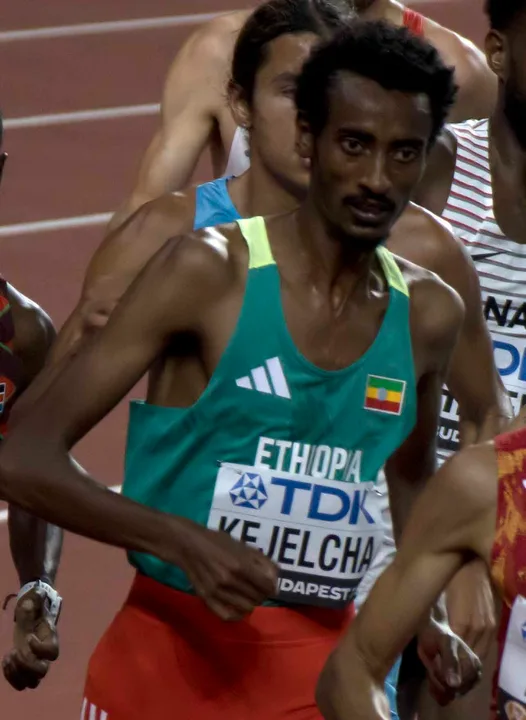
Over 21.0975 kilometres, half the distance of a marathon, Ethiopia's Yomif Kejelcha ran 56 min 51.00 s on August 23, 2026, at the Media Maratón Ciudad de Buenos Aires. That is an average of 22.26 km/h on the road.
Decade after decade, the event has come a long way. In 1967 Derek Clayton held the mark with 1 h 03 min 22 s. Matthews Temane came close to the hour in 1987 with 1 h 00 min 10 s, Paul Tergat got down to 59 min 17 s in 1998, and Geoffrey Kamworor ran 58 min 01 s in 2019. Between 1967 and 2026 the time fell by 10.3%, over 59 years.
A faster run exists that does not count: Jacob Kiplimo clocked 56:42 in Barcelona in 2025, but World Athletics did not ratify it because he had been too close to the lead car. Kejelcha, a former world indoor 3000 m champion, also made 2026 the year of his first marathon, in London, in 1:59:41: he became the second athlete to break two hours in a record-eligible race.
Related records
Sources and licences
- Value, holder and date: Wikipedia article “List of world records in athletics” (revision used 1378411308). Data from Wikipedia, licensed under CC BY-SA 4.0.
- Photo: filip bossuyt from Kortrijk, Belgium, Photo licensed under CC BY 2.0 (Wikimedia Commons). Remove this photo.
Guess another record
AthleticsLoading the question…